Guide
Morning Light and Brain Fog: Why Getting Outside Early Is Associated With Better Sleep and Alertness
Early daylight is one of the cues your body clock uses. Here is what research links with morning light, what it can and cannot tell us about fog, and easy ways to get outside.
Last updated October 17, 2026.
A small first step
- Take your first coffee or tea outside for ten minutes tomorrow, and leave the phone in your pocket.
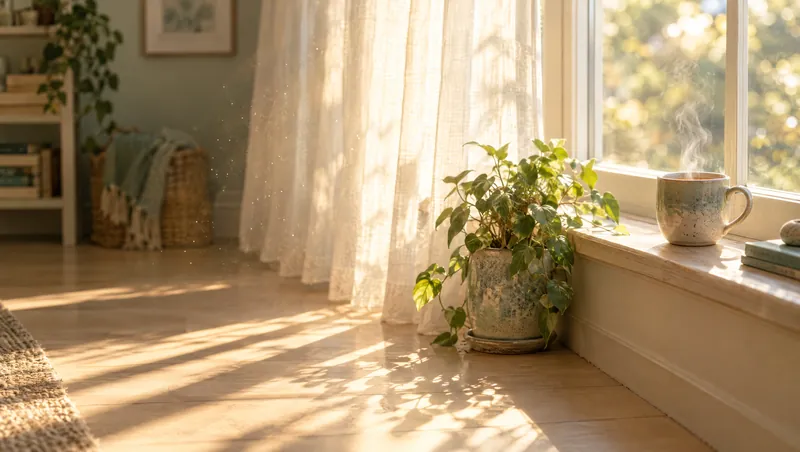
People often describe it as a brain that is buffering.
Some mornings the fog feels like it is lifting a little the moment you step outside. Is that real, or wishful thinking? This guide goes through what researchers do and do not know about morning light, how bright “bright” really is, and a few easy ways to get outside without a gadget. It is about helping your body clock, which is one piece of the puzzle. If you are not sure whether your fog is a sleepiness or a thinking problem, see what brain fog feels like.
What the body clock is, in plain terms
The NIGMS describes circadian rhythms as the physical, mental and behavioral changes your body goes through over a roughly 24-hour cycle. Light and dark have the biggest influence on them, though food, stress, physical activity, social environment and temperature also play a part.
The NHLBI explains the practical side. You have an internal “body clock” that helps decide when you feel awake and when you feel sleepy. It stays in step with cues from the environment, and light signals received through your eyes tell your brain that it is daytime. The NHLBI also notes that your body releases cortisol as the sun rises, which naturally prepares you to wake up, and that exposure to bright artificial light late in the evening, such as from a TV or computer screen, can disrupt the melatonin process and make it hard to fall asleep.
A review in Somnologie adds that the body clock’s master pacemaker, in the hypothalamus, is entrained to the 24-hour solar day through a pathway from the retina. In other words: the light that reaches your eyes helps set your clock.
What research says about morning light and sleep
A 2018 systematic review in Sleep Health pulled together 45 studies of the amount and timing of light and sleep in healthy adults living in the community. Its broad conclusions:
- Bright light (above about 1,000 lux) had positive implications for objectively measured sleep outcomes compared with dim light (below 100 lux) and moderate light (100 to 1,000 lux).
- For self-reported sleep, bright light had positive implications compared with moderate light.
- Timing mattered. Brighter morning light was consistent with a shift of the sleep period earlier in the day, and brighter morning light was associated with self-reported sleep improvement.
A 2026 narrative review in the Journal of Pineal Research looked at whether morning light can shift the body’s melatonin rhythm within the same day. It reports that modest shifts of about 10 to 30 minutes seem possible if light is delivered shortly after waking, and especially if the light is bright, blue-enriched, or delivered for a long time (over an hour). The authors also describe the same-day effect as “not well characterised” and say more targeted work is needed.
For daylight specifically, a 2022 perspective in Nature and Science of Sleep summarizes UK Biobank analyses of more than 400,000 people. It reports that more daytime hours spent outdoors were associated with less sleep inertia, fewer insomnia symptoms and an earlier sleep-wake timing. These are observational associations, so they do not prove that going outside caused the differences.
What is not known
It is worth being clear about the gaps.
- Brain fog itself. None of the sources above tested morning light as a way to clear brain fog. The links are to sleep timing and sleep quality, and a steadier sleep pattern is one of the usual early things to look at for fog. See brain fog vs fatigue.
- The first hour after waking. The 2019 sleep inertia review in Nature and Science of Sleep looked at two studies of light after waking. One found improved subjective alertness, but neither found a significant improvement on objective performance. So early light is not a proven cure for groggy mornings. More in sleep inertia.
- How much, for whom. Many of the light studies used lab light boxes, not a walk around the block, and results vary. There is no single “right dose” that we can responsibly give you.
What counts as light? Inside vs outside
The Sleep Health review gives rough lux figures to compare lighting: above 100,000 lux in sunlight, about 1,000 lux on an overcast day, about 500 in an indoor office, about 300 in a living area at home, and about 10 at twilight.
Two things follow. First, even an overcast day outdoors is brighter than a typical indoor room. Second, by those numbers, indoor light even near a window is likely to be well below what you get outside, so stepping out is the more reliable way to get a real dose of daylight.
A 2022 expert consensus in PLOS Biology, aimed at healthy adults, recommends that during the day the light reaching the eye should be at least 250 lux in a measure called melanopic EDI, and that daylight should be used first if available. That is a lighting-design guideline, not a prescription for you, but the direction is consistent: more daylight indoors and out during the day, less bright light late in the evening.
Practical ways to get morning light without a gadget
- Take the first drink outside. Coffee, tea or water on the step, balcony or yard.
- Walk a short loop. Even a few minutes before the day’s first screen counts as “outside.”
- Move your workspace. If you can, sit by the biggest window and open the blinds early.
- Make it part of something you already do. Letting the dog out, taking the bins out, walking the last stretch of a commute.
- Keep the evening end in mind. The NHS suggests avoiding phones, tablets and computers for an hour before bed, and the NHLBI notes that bright artificial light late in the evening can disrupt the process that helps you feel sleepy.
You do not need to be outside for long to try this. We did not find a reliable source that gives a minimum time, so treat any minute count as a starting point you can adjust, not a rule.
Safety notes
Never look directly at the sun. The National Eye Institute says that looking directly at the sun at any time can damage the retina and can lead to permanent loss of vision. You do not need to look at the sky to get the benefit: light reaching your eyes while you go about your morning is the point. The same goes for any bright light gadget: follow the maker’s instructions and stop if your eyes feel uncomfortable.
This guide is about brief, early-day light, not about tanning or long periods in strong sun.
When light isn’t the whole story
Light is a helper for the body clock, not a cure. If you are getting plenty of daylight and still feel sleepy and foggy most days, look at the other pieces too: your sleep schedule, caffeine timing, stress and meals. The guide to fixing brain fog covers the usual places to start.
Two patterns are worth getting looked at. The NHS describes depression as including continuous low mood, loss of interest, and disturbed sleep that persist for weeks or months and interfere with daily life. And the NHS says insomnia means you regularly have problems sleeping, and defines it as long-term when it lasts 3 months or more. If either sounds familiar, light habits are a good addition, but not a substitute for getting that checked.
Small first steps
- Tomorrow: take your first coffee or tea outside for ten minutes. Phone stays in your pocket. That is the whole practice.
- This week: do it on as many mornings as it feels easy. Missing a day is not failing.
- Notice, don’t judge: keep a one-line note on how you slept and how foggy you felt at mid-morning. After a week, look for any pattern.
- Later: if it feels good, add a second small change, such as keeping your wake-up time steady or dimming screens an hour before bed.
Sources and citations
- Circadian Rhythms — National Institute of General Medical Sciences, NIH (leaves this site)
- Sleep Deprivation and Deficiency: What Makes You Sleep? (body clock) — NHLBI, NIH (leaves this site)
- Effects of light on human circadian rhythms, sleep and mood (Somnologie, 2019) — PubMed Central / Springer (leaves this site)
- A systematic review of the amount and timing of light in association with objective and subjective sleep outcomes in community-dwelling adults (Sleep Health, 2018) — PubMed Central / Elsevier (leaves this site)
- Can Morning Light Phase Advance Human Melatonin Rhythms in Less Than 24 h? (Journal of Pineal Research, 2026) — PubMed Central / Wiley (leaves this site)
- Current Insights into Optimal Lighting for Promoting Sleep and Circadian Health: Brighter Days and the Importance of Sunlight in the Built Environment (Nature and Science of Sleep, 2022) — PubMed Central / Dove Medical Press (leaves this site)
- Recommendations for daytime, evening, and nighttime indoor light exposure to best support physiology, sleep, and wakefulness in healthy adults (PLOS Biology, 2022) — PubMed Central / PLOS (leaves this site)
- Sleep inertia: current insights (Nature and Science of Sleep, 2019) — PubMed Central / Dove Medical Press (leaves this site)
- How to watch an eclipse, safely — National Eye Institute, NIH (leaves this site)
- How to fall asleep faster and sleep better — NHS Every Mind Matters (leaves this site)
- Symptoms - Depression in adults — NHS (UK) (leaves this site)
- Insomnia — NHS (UK) (leaves this site)