Guide
Can't Sleep and Foggy? Sleep Habits Research Links With Better Rest
Sleep loss and brain fog often travel together. These research-backed sleep habits are linked with better rest, plus honest notes on what the evidence does and doesn't show.
Last updated October 17, 2026.
A small first step
- Pick a wake-up time you can keep every day this week, weekends included, and set one alarm for it. Don't change anything else yet.
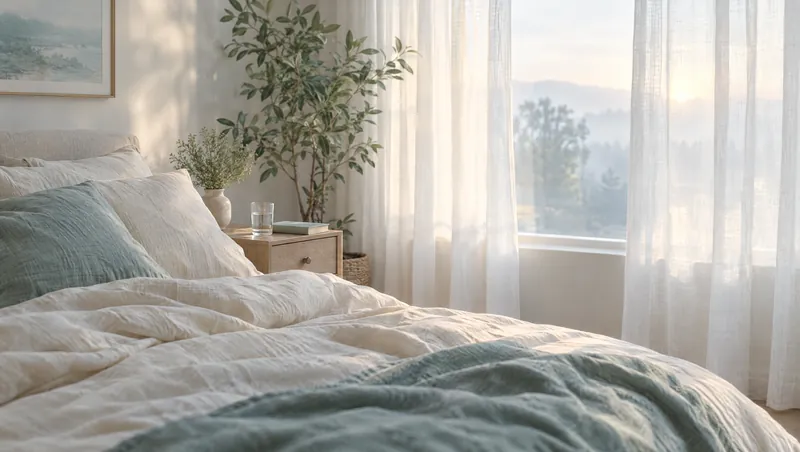
People often describe it as a brain that simply will not start.
When sleep goes wrong, thinking usually goes with it. You can’t find the word, you read the same line three times, you walk into a room and forget why. And then at night, tired as you are, you lie there wide awake.
This page covers what research links with better sleep, in the order that’s easiest to try. It also flags where popular advice is weaker than it sounds. Nothing here is a guaranteed fix for brain fog, and there’s no perfect routine. The goal is to pick a couple of habits and see how your own nights respond.
Why poor sleep and brain fog go together
The National Heart, Lung, and Blood Institute (NHLBI) says sleep deficiency can cause problems with learning, focusing and reacting. You may have trouble making decisions, solving problems and remembering things, take longer to finish tasks and make more mistakes. That list sounds a lot like brain fog.
Two more points from the NHLBI are worth knowing:
- The effect can build. After several nights of losing sleep, even just 1 to 2 hours a night, your ability to function suffers as if you hadn’t slept at all for a day or two.
- You may not notice. The NHLBI says some people may not realize they’re sleep deficient, and may still think they can function well on limited or poor-quality sleep.
For adults, the NHLBI’s general recommendation is 7 to 8 hours a day, with needs varying from person to person. Fog can have many causes, so better sleep isn’t a guaranteed fix. But sleep is one of the few levers you can try tonight, at no cost.
Habits linked with better sleep
These come from the NHLBI’s healthy sleep habits and insomnia pages. They’re guidance, not guarantees.
A steady schedule
Go to bed and wake up at the same time every day, and keep weekends within about an hour of weeknights. The NHLBI says staying up late and sleeping in on weekends can disrupt your body clock’s sleep-wake rhythm. It also says sleeping more on days off may be a sign you aren’t getting enough sleep.
If you only change one thing, make it your wake-up time. It’s easier to hold steady than a bedtime.
A calmer last hour
Use the hour before bed for quiet time. The NHLBI suggests avoiding intense exercise and bright artificial light, such as from a TV or computer screen, because the light may signal the brain that it’s time to be awake. A hot bath or relaxation techniques can be part of that wind-down. Breathing exercises for brain fog has a few simple ones.
Caffeine and alcohol timing
The NHLBI says caffeine’s effects can last up to 8 hours, so a coffee in the late afternoon can make it hard to fall asleep. It also suggests avoiding nicotine and avoiding alcoholic drinks before bed. The reason: although alcohol can make it easier to fall asleep, it can make sleep lighter than normal, which makes waking during the night more likely.
If you’re curious how this plays out for you, see caffeine and brain fog and does alcohol help you sleep.
Food and drink in the evening
Avoid heavy or large meals within a few hours of bedtime (a light snack is fine). The NHLBI also suggests limiting how much you drink close to bedtime, which may help you sleep longer without bathroom trips.
Daylight and movement
Spend time outside every day when possible, and be physically active. A meta-analysis of 66 studies found that regular exercise had small benefits for total sleep time and sleep efficiency, small-to-medium benefits for how fast people fall asleep, and moderate benefits for sleep quality. The NHLBI notes that exercising close to bedtime can make it harder to fall asleep, and suggests finishing at least 5 to 6 hours before bed. Morning light is its own topic: see morning light and brain fog.
A cool, quiet, dark room
Keep your bedroom cool, quiet and dark; a dim night light is fine if you need one. The NHLBI also suggests avoiding TV and electronic devices in the bedroom, because their light can disrupt your sleep-wake cycle.
Naps, with care
Short naps may raise alertness for a while. If you have trouble falling asleep at night, the NHLBI suggests limiting naps or taking them earlier in the afternoon, and keeping them to 20 minutes or less. Napping can’t fully make up for lost nighttime sleep.
A popular fix with weak evidence: blue-light glasses
Blue-light filtering glasses are sold as a sleep aid. A 2023 Cochrane review of 17 randomized trials found their effect on sleep quality to be indeterminate, with mixed results across small, varied studies. None of the studies had a low risk of bias throughout. That doesn’t prove they don’t work, only that the evidence isn’t there yet. Dimming screens and putting them away in the last hour costs nothing and matches the NHLBI’s advice.
If you’ve been lying awake for months
Trouble sleeping that goes on for months is called chronic insomnia, and habits alone don’t always settle it. The NHLBI describes cognitive behavioral therapy for insomnia (CBT-I) as a 6- to 8-week program, usually recommended as the first treatment option for long-term insomnia, that can be done with a clinician in person, by phone or online. Parts of it include sleep restriction and stimulus control, such as getting out of bed if you can’t sleep so the bed is linked with sleeping.
The American College of Physicians’ guideline recommends CBT-I as the initial treatment for chronic insomnia in adults (a strong recommendation based on moderate-quality evidence). It suggests discussing the benefits, harms and costs of short-term medicines only when CBT-I alone hasn’t worked. We don’t recommend or compare medicines here; that’s a conversation between you and a clinician.
When it isn’t just habits
Sleep that doesn’t refresh you even when you spend enough time in bed can have other causes. The NHLBI says to talk with your doctor if you sleep more than 8 hours a night but don’t feel well rested, because you may have a sleep disorder. Sleep apnea is one example: loud snoring, waking up gasping and morning headaches are on the NHLBI’s symptom list. Our guide to sleep apnea and brain fog explains the signs.
One safety note: if you’re so sleepy that you’re nodding off while driving, don’t drive. Pull over somewhere safe. The NHLBI says sleepy drivers may feel able to drive, yet studies show sleep deficiency can harm driving ability as much as or more than being drunk.
Small first steps
Sleep habits work best when you stack them slowly. Picking a handful at once is how people give up by Thursday.
- Week one: fix your wake-up time. That’s it.
- Week two: move your last coffee earlier, and see how you feel.
- Week three: add a quiet last hour, with screens dimmed or away.
- Along the way: go outside once a day and move your body in whatever way you like.
- Track the result in the brain fog symptom diary. Two weeks of notes can show whether any of this is working for you.
If mornings are the hardest part, sleep inertia covers why waking up can feel so groggy. For the full picture, the guide to finding your cause places sleep next to the other levers, and what brain fog feels like is a good starting point if you’re still putting words to it.
Sources and citations
- Sleep Deprivation and Deficiency: Healthy Sleep Habits — NHLBI, National Institutes of Health (leaves this site)
- Sleep Deprivation and Deficiency: How Sleep Affects Your Health — NHLBI, National Institutes of Health (leaves this site)
- Sleep Deprivation and Deficiency: How Much Sleep Is Enough — NHLBI, National Institutes of Health (leaves this site)
- Insomnia: Treatment — NHLBI, National Institutes of Health (leaves this site)
- Management of Chronic Insomnia Disorder in Adults: A Clinical Practice Guideline From the American College of Physicians (2016) — Annals of Internal Medicine, via PubMed (leaves this site)
- The effects of physical activity on sleep: a meta-analytic review (Kredlow et al., 2015) — Journal of Behavioral Medicine, via PubMed (leaves this site)
- Blue-light filtering spectacle lenses for visual performance, sleep, and macular health in adults (Singh et al., 2023) — Cochrane Database of Systematic Reviews, via PubMed (leaves this site)
- Sleep Apnea: Symptoms — NHLBI, National Institutes of Health (leaves this site)